

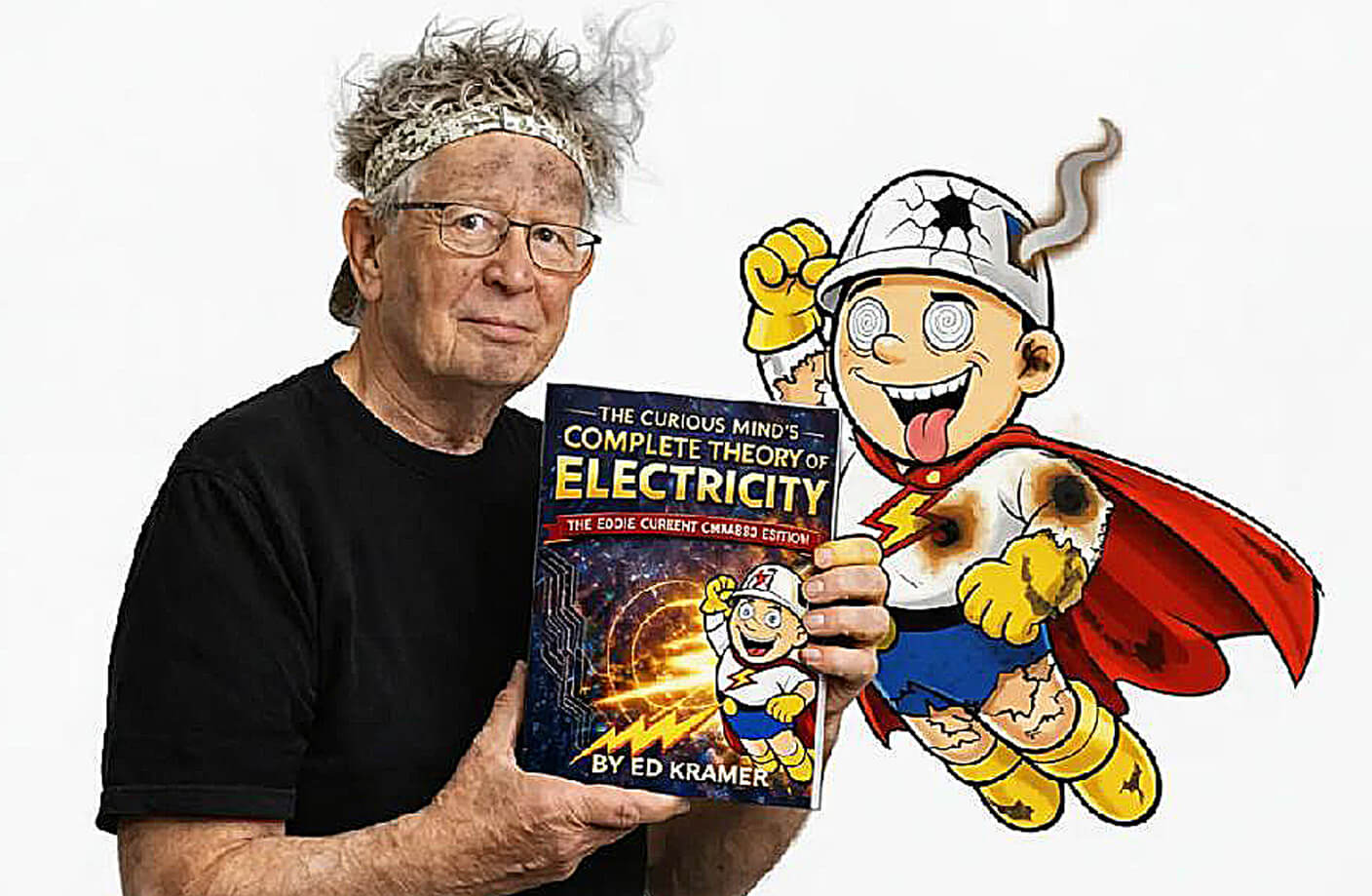
By Ed Kramer
Here you will find 10 reasons to increase effectiveness in teaching. When people think about learning, they often imagine textbooks, lectures, formulas, and exams. Rarely do they think about laughter. Yet humor may be one of the most powerful teaching tools. available.
Whether you’re teaching electrical theory, writing a book, presenting a seminar, or simply explaining an idea to a friend, humor can turn information into understanding and understanding into memory.
In fact, some of the most memorable lessons people retain are attached to a story, a joke, or a moment that made them smile.
Which are your favorites? – pick your favorite 3.
1. Humor Makes Information Memorable
People may forget a definition, but they rarely forget a funny story. When students laugh, they create an emotional connection to the material. That connection acts like a mental bookmark, making it easier to recall the lesson later.
Ask someone how electricity works, and they might struggle to explain voltage and current. Tell them a story about Eddie Current getting stuck in a traffic jam of electrons, and suddenly the concept becomes unforgettable.
2. Humor Reduces Anxiety
Many subjects can be intimidating.
Mathematics. Science. Electrical theory. Technology.
A little humor lowers the emotional barriers that often prevent learning. When students relax, they become more willing to ask questions, participate, and take intellectual risks.
Humor says, “It’s okay not to know everything. We’re all learning together.”
3. Humor Keeps Attention Focused
Today’s students and readers compete with smartphones, social media, and endless distractions.
Humor acts like a reset button. Just when attention begins to drift, a clever analogy, amusing illustration, or unexpected punchline pulls people back into the lesson.
A smile can accomplish what three additional slides often cannot.
4. Humor Makes Complex Ideas Simpler
Good humor often depends on comparison and exaggeration—the same tools used in effective teaching.
Electrical resistance becomes traffic congestion. A capacitor becomes a tiny rechargeable bucket. A transformer becomes a voltage-changing magician.
These humorous comparisons help people visualize concepts that would otherwise seem abstract and difficult.
⚡😄 FOOTNOTE: Humor Keeps the Author Awake While Writing About Electrical Theory. Without it, even the electrons start nodding off, and you are half way thru.⚡😄
5. Humor Builds Connection
People learn better from teachers and writers they like.
Humor makes instructors appear more approachable and human. It creates trust and rapport between the person teaching and the person learning. Students may not remember every lesson, but they remember how a teacher made them feel.
6. Humor Encourages Curiosity
Curiosity begins with engagement.
When readers enjoy what they’re reading, they naturally want to learn more. Humor transforms learning from an obligation into an adventure.
Instead of asking, “Do I have to read this?” People begin asking, “What happens next?”
That’s a powerful shift.
7. Humor Helps Difficult Lessons Stick
Many educators have experienced the same phenomenon: students remember the funny example years after they have forgotten the formal definition.
The joke becomes the handle that allows the brain to retrieve the information attached to it. In other words, humor isn’t a distraction from learning. It’s often the delivery system.
8. Humor Makes Writing More Human
Readers connect with personality. Facts are important, but facts alone rarely inspire people to keep turning pages. Humor adds warmth, character, and authenticity. It reminds readers there is a real person behind the words.
9. Humor Encourages Creativity
Humor and creativity are close cousins.
Both involve looking at familiar things from unexpected angles. When students and readers encounter humor, they become more open to alternative ways of thinking and problem-solving. Many inventions, discoveries, and innovations began with someone asking, “What if?”
Humor encourages that same spirit of exploration.
In technical fields, creative thinking often leads to better solutions. In writing, it leads to more engaging stories. In life, it helps people adapt to challenges with greater flexibility and optimism.
A mind that laughs is often a mind that is ready to imagine.
10. Humor Creates Shared Experiences
One of the greatest benefits of humor is its ability to bring people together.
A classroom that laughs together becomes a community. A reader who laughs with an author feels a personal connection. A team that shares humor often communicates more effectively and works together more comfortably.
Humor reminds us that learning is not merely the transfer of information; it is a shared human experience.
Long after students forget specific lessons, they often remember the teacher who made learning enjoyable. Long after readers forget individual facts, they remember the writer who made them smile. Humor creates memories that connect people long after the lesson is over.
The Bottom Line
Humor isn’t the opposite of serious learning. Humor is one of the most effective pathways to serious learning. Whether you’re writing about electricity, travel, photography, or everyday life, humor invites readers into the conversation.
A smile opens the mind. A laugh captures attention. A memorable story turns information into understanding.
That’s why some of the best teachers, writers, and speakers throughout history have understood a simple truth: People learn best when they enjoy the journey. And sometimes the shortest distance between confusion and understanding is a well-timed joke. An Eddie Current approved” ending:⚡😊
“If electricity can travel thousands of miles through a wire, perhaps a little humor can travel even farther through the human mind.”